


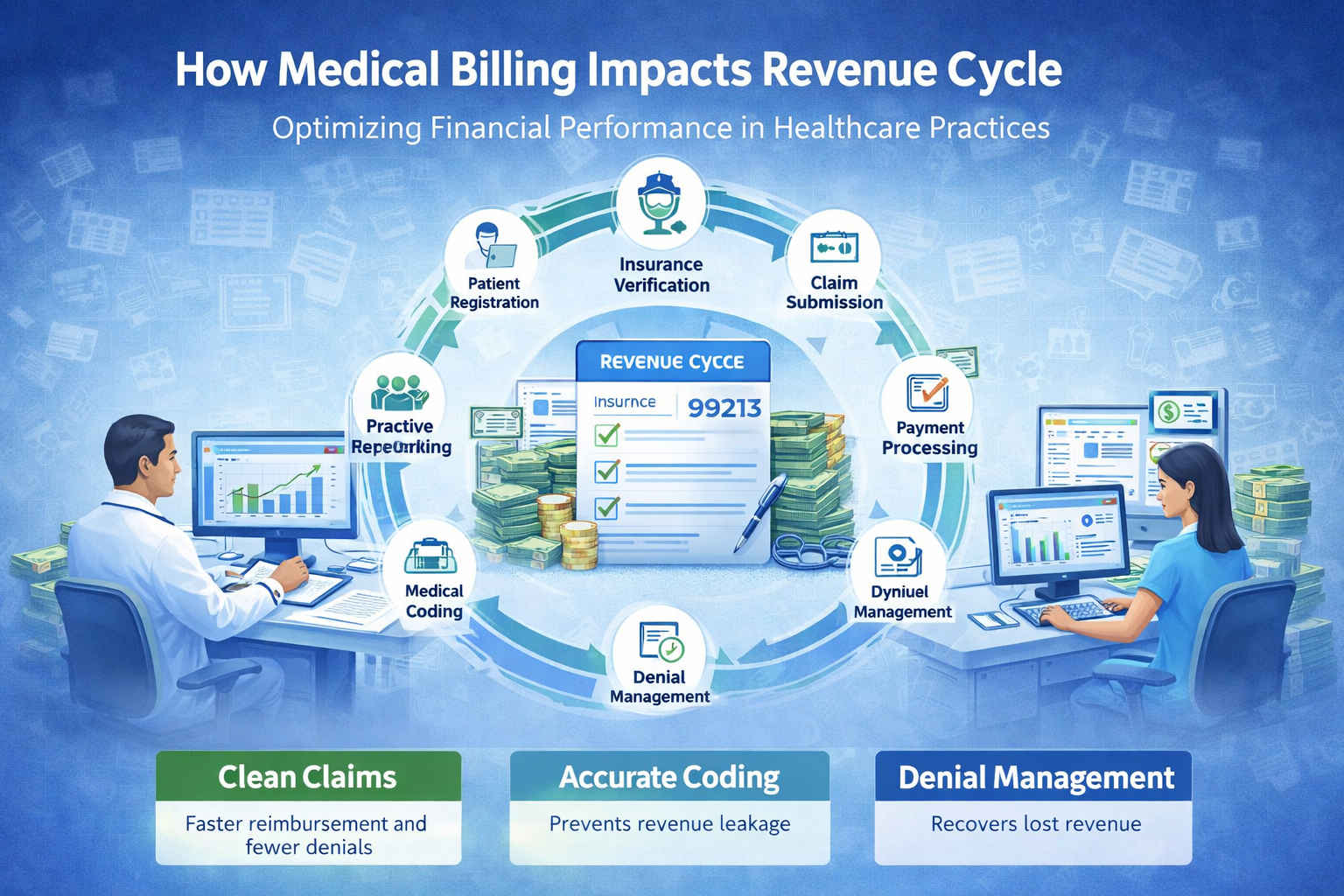
Revenue Cycle Management (RCM) is the financial backbone of every healthcare practice, encompassing all administrative and clinical functions that contribute to revenue generation. Medical billing is a central component of RCM, directly influencing how efficiently a practice captures charges, submits claims, receives payments, and manages denials. When medical billing is accurate and well-managed, the entire revenue cycle becomes more predictable and profitable.
This article explains how medical billing impacts revenue cycle management and why optimizing billing processes is essential for financial success in healthcare practices.
Understanding Revenue Cycle Management in Healthcare
Revenue Cycle Management refers to the end-to-end process of managing patient revenue, from appointment scheduling to final payment collection. It integrates front-end operations, clinical documentation, coding, billing, and collections.
Key Components of RCM
- Patient scheduling and registration
- Insurance verification and authorization
- Clinical documentation and coding
- Claim submission and follow-up
- Payment posting and collections
- Reporting and financial analysis
Medical billing connects each of these components and ensures they function as a unified system.
The Role of Medical Billing in the Revenue Cycle
Medical billing acts as the operational engine of RCM. It translates clinical services into claims and manages the flow of revenue back into the practice.
Bridging Clinical Care and Payments
Without accurate medical billing, even the highest-quality patient care may not result in proper reimbursement. Billing ensures that services rendered are correctly communicated to insurance payers.
Front-End Billing Accuracy and Its Impact
Revenue cycle performance begins at the front end of patient interactions.
Patient Registration and Insurance Verification
Accurate demographic data and insurance verification prevent eligibility-related denials. Errors at this stage often lead to delayed or unpaid claims, disrupting the revenue cycle.
Prior Authorizations and Benefits Checks
Medical billing teams ensure required authorizations are obtained in advance, reducing claim rejections and revenue leakage.
Medical Coding and Charge Capture
Accurate coding is essential for effective revenue cycle management.
Preventing Revenue Leakage
Missed charges, incorrect codes, or missing modifiers can result in underbilling. Medical billing ensures all billable services are captured and reimbursed appropriately.
Compliance and Medical Necessity
Proper coding supports medical necessity requirements, reducing audit risks and improving approval rates.
Claim Submission and Reimbursement Speed
Claim submission is one of the most visible ways medical billing affects RCM.
Clean Claims and First-Pass Acceptance
Medical billing teams focus on submitting clean claims that meet payer guidelines. High first-pass acceptance rates accelerate payments and stabilize cash flow.
Electronic Claim Management
Electronic billing systems improve tracking, reduce errors, and shorten reimbursement cycles.
Denial Management and Revenue Recovery
Denial management is a critical RCM function influenced by medical billing.
Identifying Denial Trends
Billing teams analyze denial patterns to address recurring issues such as coding errors or eligibility gaps.
Appeals and Follow-Up
Timely appeals and corrections help recover revenue that would otherwise be lost, strengthening the revenue cycle.
Accounts Receivable Management
Medical billing directly affects how quickly outstanding balances are collected.
Reducing Days in Accounts Receivable
Efficient billing and follow-up reduce AR days, improving liquidity and financial predictability.
Patient Balance Collections
Clear and accurate patient statements increase collection rates and reduce bad debt.
Reporting and Revenue Cycle Visibility
Medical billing provides actionable insights into RCM performance.
Performance Metrics and KPIs
Billing reports track key metrics such as denial rates, collection ratios, and payer turnaround times.
Data-Driven Improvements
Accurate data enables practices to refine workflows, negotiate payer contracts, and plan for growth.
The Impact of Poor Medical Billing on RCM
Inefficient billing creates bottlenecks throughout the revenue cycle.
Common Consequences
- Increased claim denials
- Delayed reimbursements
- Higher administrative costs
- Reduced patient satisfaction
Over time, these issues weaken financial stability.
Strengthening Revenue Cycle Management Through Medical Billing
Healthcare practices can improve RCM performance by optimizing billing operations.
Staff Training and Technology
Regular training and modern billing software improve accuracy and efficiency.
Outsourcing Medical Billing Services
Professional medical billing services bring expertise, compliance knowledge, and scalable solutions that enhance revenue cycle performance.
Conclusion
Medical billing plays a vital role in revenue cycle management by ensuring accurate claim submission, timely reimbursements, and effective denial resolution. A strong billing process strengthens every stage of the revenue cycle, from patient intake to final payment.
By investing in efficient medical billing practices or partnering with experienced billing services, healthcare providers can improve cash flow, reduce revenue leakage, and build a more resilient revenue cycle.