


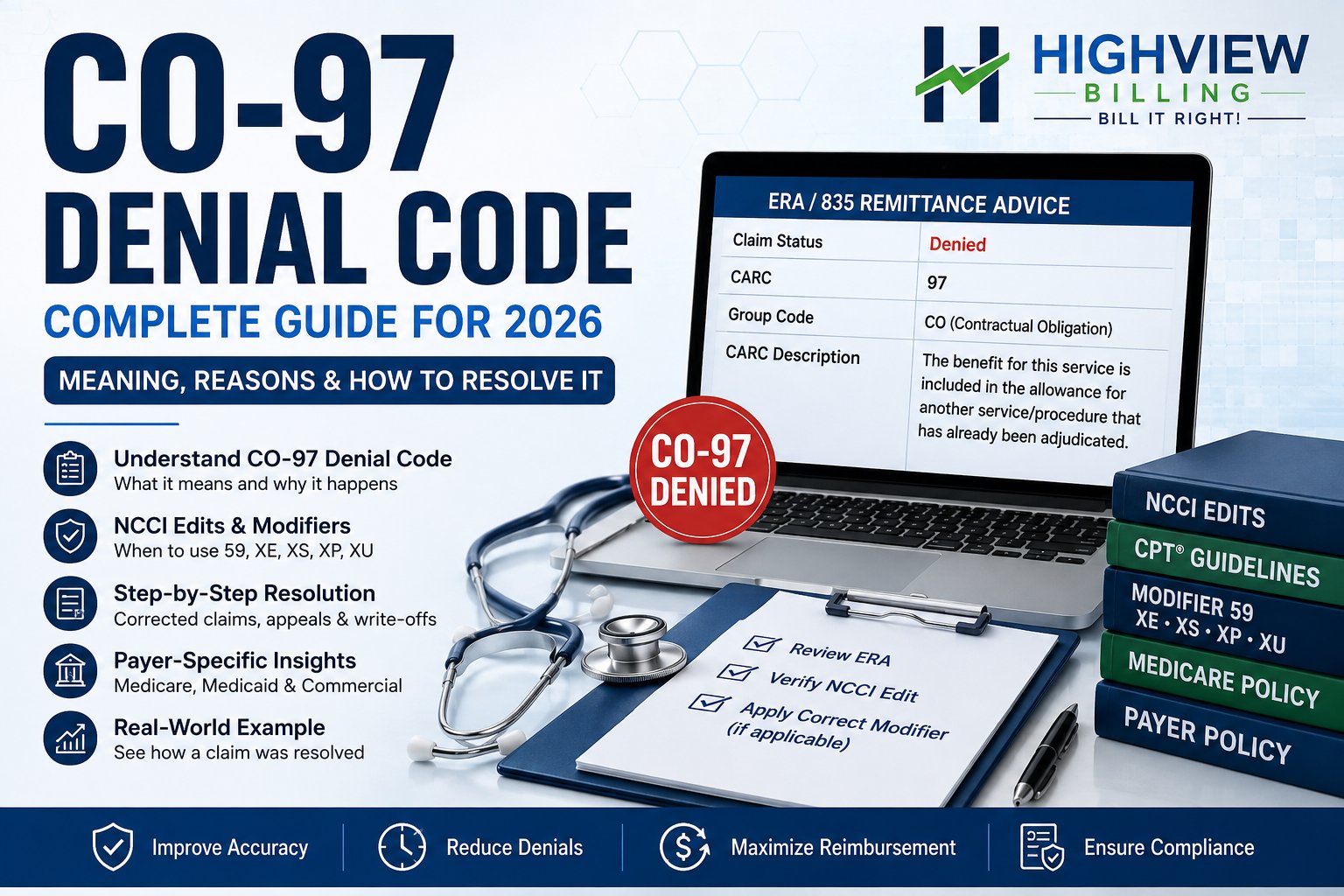
Quick Answer: What Does CO-97 Mean?
Specifically, CO-97 is a Claim Adjustment Reason Code (CARC) meaning that the benefit for the billed service is included in the payment or allowance for another service or procedure that has already been adjudicated. The correct response is not automatically to add Modifier 59. First review the ERA/835, related claim lines, any accompanying remark or policy information, the applicable NCCI edit and modifier indicator where relevant, the medical record, and the payer’s own policy.
Introduction
Encountering a CO-97 denial code on your Electronic Remittance Advice (ERA) can look simple at first glance, but the proper resolution often requires several layers of investigation. The payer may be applying an NCCI procedure-to-procedure edit, a global surgical package rule, or a payer-specific bundling policy.
For a medical billing team, the practical question goes beyond simply asking, “What does CO-97 denial code mean?” Instead, you must ask: “Why did this specific line receive a CO-97 denial code, is the payer’s decision correct, and what is the compliant next action?”
We wrote this guide for U.S. medical practices, physician groups, outpatient organizations, billing companies, coders, and revenue-cycle teams that need a defensible workflow for investigating CO-97 adjustments.
Why Do Claims Receive a CO-97 Denial Code Adjustment?
Specifically, X12 defines CARC 97 as: “The benefit for this service is included in the payment/allowance for another service/procedure that has already been adjudicated.” In practical terms, the payer has determined that the denied service is not separately payable because payment or allowance has already been made for another adjudicated service.
Furthermore, the related service may appear on the same claim or may involve a previously adjudicated claim, depending on the payer’s processing logic.
Although CO-97 is technically a CARC used in claim adjustment reporting, in everyday revenue-cycle work, teams often call the affected line a “CO-97 denial” because the line may be reduced to zero or otherwise denied for separate payment. Ultimately, keeping the terminology distinction clear helps when interpreting an ERA and communicating with a payer.
What Does “CO” Mean in CO-97?
“CO” is the Claim Adjustment Group Code for Contractual Obligation. X12 explains that group codes generally identify responsibility for adjustment amounts. A CO adjustment therefore needs to be evaluated with the provider’s contract and applicable payer requirements before any patient-balance decision is made.
Do not treat the CO group code as a universal instruction to bill, write off, or transfer a balance without checking the applicable contract, payer policy, and claim circumstances.
CO-97 vs. NCCI: Why the Distinction Matters
CO-97 denial code is the remittance adjustment reason. NCCI is one possible framework that can explain why two services are not separately reportable under Medicare rules. CMS states that NCCI PTP edits prevent inappropriate payment of services that should not be reported together; a PTP edit contains a Column One and Column Two code, and the Column Two code is denied when the edit applies unless an appropriate NCCI-associated modifier is permitted and reported.
That means CO-97 denial code should not be treated as synonymous with “NCCI edit.” A payer can use CO-97 denial code in circumstances that involve bundling or inclusion rules outside a specific Medicare NCCI PTP edit, particularly when a commercial payer applies its own policy. Always investigate the actual remittance and payer policy.
CO-97 Denial Code at a Glance
| Item | What It Means |
| Code | CO-97 |
| Code type | CARC — Claim Adjustment Reason Code |
| Group code | CO — Contractual Obligation |
| Core meaning | Service is included in payment/allowance for another adjudicated service |
| Common investigation path | ERA/835 → related line → RARC/policy information → NCCI/payer rule → documentation → resolution |
| Potential outcomes | Corrected claim, appeal/reconsideration, or contractual adjustment, depending on facts |
| First source to verify | X12 definition + payer remittance information |
Why Do Claims Receive a CO-97 Denial Code Adjustment?
Furthermore, billers must identify the reason behind a CO-97 adjustment before changing a modifier, resubmitting a claim, or posting a write-off. Common scenarios include:
-
Bundled or included services: A payer may consider one service part of another service or procedure that has already been adjudicated. The correct resolution depends on the coding rules, payer policy, documentation, and claim context.
-
NCCI procedure-to-procedure (PTP) edit: For Medicare NCCI PTP edits, CMS identifies code pairs that should not be reported together. The applicable edit version and Correct Coding Modifier Indicator (CCMI) matter.
-
Comprehensive/component coding relationship: A component service can be included in a more comprehensive code under coding rules, making separate reporting inappropriate unless an applicable exception is supported.
-
Missing or incorrect modifier: Moreover, a modifier remains relevant when services are clinically distinct and applicable edit/payer rules permit separate reporting.The documentation must support the distinction before the modifier is added.
-
Global surgical package: A service may fall within the applicable global surgical package for a related procedure. Medicare uses global indicators such as 000, 010, and 090 for covered postoperative packages, with specific modifier rules for unrelated or separately reportable services.
-
Incorrect CPT/HCPCS selection: A coding error can create an apparent bundling problem if a comprehensive code and an included component are reported together.
-
Overlapping same-day services: Some services may overlap in the work performed or be considered integral to another service.
-
Commercial or payer-specific bundling rules: Commercial and other payers may apply policies or edits that are not identical to Medicare NCCI. Verify the payer-specific policy and the effective date.
CO-97 and NCCI PTP Edits: How to Tell Whether the Edit Can Be Bypassed
CMS explains that each Medicare NCCI PTP edit has Column One and Column Two codes. When the edit applies to the same beneficiary on the same date of service, Consequently, Column One remains eligible for payment, whereas payers deny Column Two unless teams permit and report an appropriate NCCI-associated modifier.
Understanding the Correct Coding Modifier Indicator (CCMI)
| CCMI | Meaning | Practical Implication |
| 0 | NCCI PTP-associated modifiers cannot be used to bypass the edit. | Do not add a modifier to override the edit. Investigate whether the services were reported incorrectly or whether another payer-specific issue exists. |
| 1 | NCCI PTP-associated modifiers may be used to bypass the edit under appropriate circumstances. | A modifier may be appropriate only when the clinical circumstances and documentation support separate reporting. |
| 9 | The use of NCCI PTP-associated modifiers is not specified. | Do not treat CCMI 9 as a green light to append a modifier. Review the applicable NCCI and payer guidance. |
NCCI Version Control: Check the Date of Service
NCCI PTP files are updated quarterly. CMS currently lists the Medicare practitioner PTP files for Quarter 3 of 2026 as version 32.2, effective July 1, 2026. The correct edit version is tied to the applicable date-of-service period; do not assume today’s edit table is the one that governed an older claim.
Official resource: CMS Medicare NCCI PTP Edits
Modifier 59 and CO-97: When Does It Help?
Modifier 59 is frequently associated with CO-97 research, but it should never be treated as a universal fix. CMS guidance requires the medical record and clinical circumstances to support the reporting of the services as distinct.
When Modifier 59 May Be Appropriate
-
The services are genuinely distinct under the applicable coding guidance.
-
The relevant NCCI edit permits use of an NCCI-associated modifier (for example, CCMI 1 for an applicable PTP pair).
-
Documentation clearly identifies the circumstances that make the services separately reportable.
-
A more specific modifier, such as XE, XS, XP, or XU, is not more appropriate for the documented situation.
When Modifier 59 Should Not Be Used
-
The applicable PTP edit has CCMI 0.
-
The services were actually part of the same procedure or encounter and are not separately reportable.
-
Documentation does not support the distinct service.
-
The modifier is being added solely because the payer denied the line with CO-97.
Modifier 59 vs. XE, XS, XP and XU
| Modifier | General Concept | Use Only When Documentation Supports |
| 59 | Distinct procedural service | The service is distinct and separate under applicable coding rules. |
| XE | Separate encounter | Separate encounter on the same date, when the more specific X modifier is appropriate. |
| XS | Separate structure | Different anatomical structure, when supported. |
| XP | Separate practitioner | Different practitioner performed the service, when supported. |
| XU | Unusual non-overlapping service | Service does not overlap usual components of the primary procedure, when supported. |
How CO-97 Appears in an 835 ERA
A medical billing professional should be able to connect the remittance adjustment to the affected claim line rather than relying only on a denial summary screen. X12 identifies CARC 97 as an adjustment reason and notes that the 835 Healthcare Policy Identification information may provide additional payer policy context when present.
Illustrative 835 Example
The following is an illustrative, simplified example only. It is not a complete 835 transaction and should not be copied into production EDI.
Plaintext
CAS*CO*97*50~
LQ*HE*<RARC_OR_POLICY_REFERENCE>~
Interpretation: The service line has a contractual-obligation adjustment with CARC 97. The actual production ERA may contain other segments and identifiers, and the payer’s remark/policy information must be interpreted with the relevant claim line.
For advanced billing teams, the practical workflow is:
-
Identify the affected service line
-
Identify the related paid/adjudicated service
-
Review the accompanying remark/policy information
-
Check the applicable coding edit and payer policy
-
Review documentation
-
Determine the correct resolution
How an Experienced Biller Investigates a CO-97 Before Rebilling
-
Start with the full ERA/835: Record the denied CPT/HCPCS, paid or adjudicated related line, adjustment amount, modifiers, date of service, units, and any accompanying remark/policy information.
-
Identify what the payer considers inclusive: Determine the other service/procedure that the payer says already includes the denied line. Do not assume the answer is the same code every time.
-
Check the applicable edit or coding rule: For Medicare, check the date-appropriate NCCI PTP file and CCMI where an edit exists. For commercial or other payers, also check the payer’s own bundling policy.
-
Review the medical record: Look for documentation that establishes whether the services were distinct, separately medically necessary, unrelated, performed at different encounters/sites, or otherwise separately reportable.
-
Select the correct resolution: The correct outcome may be a corrected claim, a modifier-supported resubmission, an appeal/reconsideration, or a contractual adjustment.
-
Record the root cause: Track the code pair, payer, provider, specialty, and reason so recurring CO-97 patterns can be prevented.
Common CO-97 Denial Code Examples & Scenarios
Example 1: E/M + Same-Day Procedure
Hypothetical scenario: An established-patient E/M code (such as CPT code 99214) is billed on the same date denial code. The correct question is not “Can we add Modifier 25?” but “Does the documentation support a significant, separately identifiable E/M service beyond the work inherent in the procedure, and do the applicable coding edits/payer rules permit separate reporting?”
If the answer is yes and the relevant rules support the modifier, Modifier 25 may be appropriate on the E/M line. If the only purpose of the visit was to perform the procedure, the CO-97 denial code adjustment may be correct.
Example 2: NCCI PTP Edit
Hypothetical scenario: Two CPT/HCPCS codes are reported for the same beneficiary on the same date of service and the payer applies an NCCI PTP edit. Confirm the exact code pair in the applicable NCCI file and review the CCMI. If the CCMI is 0, an NCCI-associated modifier cannot override the edit. If the CCMI is 1, the modifier still requires appropriate clinical circumstances and documentation.
Example 3: Postoperative Global Period
Hypothetical scenario: An office visit is reported during the global period of a related procedure and the line receives an inclusion-type adjustment. For Medicare, check the procedure’s global indicator and whether the visit represents included routine postoperative care or an unrelated/separately reportable service. Modifier 24 or 79 may be relevant only when the applicable criteria are met.
Example 4: Physical Therapy Bundling Review
A therapy practice may see a bundling adjustment involving two same-day therapy procedures. The resolution should start with the exact code pair, the applicable NCCI edit, units and documentation—not with a default modifier. This kind of specialty-specific example is useful because the underlying coding relationship may differ from office-visit/procedure scenarios.
Real-World CO-97 Case Study
| Case Element | What to Document |
| Specialty | Multispecialty Outpatient Practice |
| Payer | Commercial Payer / Medicare Part B |
| Denied Code | CPT 99213 (Established Patient Office Visit) receiving CO-97 |
| Related Line | CPT Procedure Code billed on the same date of service |
| Root Cause | NCCI edit, global-period inclusion, coding relationship, payer policy, etc. |
| Evidence Reviewed | ERA/RARC, NCCI version, medical record, payer policy |
| Action | Corrected claim, appeal/reconsideration, or contractual adjustment |
| Outcome | Successfully adjudicated and paid via corrected claim and proper modifier |
Case Analysis & Workflow
-
Step 1 — Review the ERA/835: Identify the affected CPT/HCPCS line, the related paid or adjudicated line, the adjustment amount, modifiers already reported, the date of service, and any accompanying remark or payer-policy information.
-
Step 2 — Identify the underlying rule: For Medicare, check the date-appropriate NCCI PTP file and review the CCMI if a PTP edit exists. For commercial claims, also check the payer’s published policy and contract because commercial edits are not necessarily identical to Medicare NCCI.
-
Step 3 — Review documentation: Determine whether the services were genuinely distinct, separately reportable, unrelated, or otherwise supported under the applicable coding guidance.
-
Step 4 — Choose the resolution: If the original coding was wrong, correct and resubmit according to payer rules. If the services were distinct and the payer incorrectly bundled them, a corrected claim or appeal/reconsideration may be appropriate. If the services were legitimately included, the adjustment may be contractually correct.
What this case teaches: The safest CO-97 workflow is evidence-first: remittance → underlying rule → documentation → payer policy → resolution. A modifier should be the result of that analysis, not the starting assumption.
CO-97: Corrected Claim vs. Appeal vs. Contractual Adjustment
| Situation | Likely Action | What to Verify | Common Mistake |
| Coding error on the original claim | Correct and resubmit if payer rules permit | Correct code selection, claim frequency code, payer submission rules | Adding a modifier instead of fixing the code |
| Distinct service was documented but modifier was missing | Corrected claim or payer-specific reconsideration | Applicable edit/CCMI, documentation, payer rules | Appending Modifier 59 without clinical support |
| Payer applied an incorrect edit | Appeal/reconsideration |
Applicable NCCI version, payer policy, chart support |
Appealing without proving the coding basis |
| Service was legitimately included | Contractual adjustment/write-off per contract/payer policy |
Contract, fee schedule, global period, payer guidance |
Trying to force payment with an unsupported modifier |
Can a CO-97 Adjustment Be Appealed?
Yes, when the payer’s adjustment is incorrect and the claim documentation supports separate reporting. Do not appeal every CO-97 line automatically.
When an Appeal or Reconsideration May Be Appropriate
-
The payer applied an edit that does not exist for the code pair or the applicable date-of-service version.
-
The payer’s own published policy supports separate reporting and the claim was processed contrary to that policy.
-
The documentation establishes distinct services and the applicable coding rules permit separate reporting.
-
A global-period inclusion does not apply because the service was unrelated or otherwise separately reportable under the applicable rules.
What to Include in the Appeal
-
A concise cover letter stating exactly why the adjustment is incorrect.
-
The affected claim line(s) and related paid/adjudicated line(s).
-
Relevant NCCI edit information for the applicable version, when NCCI is involved.
-
Medical-record documentation supporting the separate service.
-
The applicable payer policy or contract language when it supports the appeal.
-
A clear modifier rationale only when a modifier is actually supported.
Appeal Deadline
Do not publish a universal appeal deadline for CO-97 denial code. Appeal and reconsideration windows vary by payer and contract. Verify the ERA, payer provider manual, portal instructions, or participating-provider agreement for the claim-specific deadline.
Medicare, Medicaid and Commercial Payers: What Changes?
CO-97 is a standardized CARC, but the coding and claim-processing rules used to arrive at an adjustment can differ by payer[cite: 1, 2]. Medicare NCCI is maintained by CMS; Medicaid NCCI is a separate CMS program and state Medicaid agencies implement applicable edits through their own processing environment; commercial payers may use their own policies or proprietary edits.
| Payer Environment | What to Verify | Primary Reference Point | Practical Caution |
| Medicare |
Date-appropriate NCCI PTP file, CCMI, Medicare policy |
CMS NCCI + MAC guidance |
Do not use a later NCCI version for an older date of service. |
| Medicaid | Applicable state program + current Medicaid NCCI resources | CMS Medicaid NCCI + state Medicaid guidance | CMS files do not replace state implementation guidance. |
| Commercial | Payer-specific bundling policy, contract, fee schedule, portal/ERA information | The specific payer | Do not assume Medicare NCCI is the complete commercial-payer rule set. |
CO-97 and the Global Surgical Package
For Medicare, global surgical-package concepts can make certain postoperative services included in the payment for a related procedure. Before treating a CO-97 line as a global-period adjustment, verify the procedure’s global indicator and whether the service falls within the included package. CMS resources use global indicators such as 000, 010 and 090 for Medicare procedure status.
Modifier selection is situation-specific. For example, Modifier 24 may be relevant to an unrelated E/M service during a postoperative period, while Modifier 79 may apply to an unrelated procedure during the postoperative period when the applicable criteria are met. Modifier 25 addresses a separate E/M service on the same day as a procedure; it is not a universal global-period bypass.
5 Common Mistakes When Handling CO-97
| Mistake | Why It Creates Risk |
| Automatically adding Modifier 59 | A denial code is not, by itself, documentation of a distinct service. |
| Checking today’s NCCI table instead of the date-of-service version |
NCCI PTP files are updated quarterly; the historical version matters. |
| Treating CO-97 as proof of an NCCI edit | First establish the actual payer rule or edit that produced the adjustment[cite: 1, 2]. |
| Appealing without evidence | A strong appeal identifies the code pair, rule, documentation, and exact reason the payer’s decision is wrong. |
| Moving the balance to the patient without contract review |
The CO group code signals a contractual obligation, but patient-balance treatment still needs to follow the applicable contract and payer requirements. |
How to Prevent CO-97 Denial Code Issues in Billing
-
Pre-submission claim scrubbing: Use claim-editing tools that incorporate relevant coding edits and payer rules before claims are submitted.
-
Quarterly NCCI review: Track changes in Medicare NCCI PTP files and update internal coding tools/processes accordingly.
-
Provider documentation education: Teach clinicians what documentation is needed when services are genuinely separate or distinct.
-
Modifier governance: Create a policy for when modifiers 25, 59, XE, XS, XP and XU may be used, and require documentation support.
-
Denial trend analysis: Track CO-97 by payer, provider, specialty and code pair to identify repeat root causes.
-
Denial work queue: Route CO-97 to a specific workflow rather than treating it like every other denial type.
-
Root-cause reporting: Measure corrected-claim outcomes, appeal overturns, repeat denials and write-offs to identify systemic problems.
CO-97 Denial Resolution Workflow
Plaintext
[CO-97 appears on the ERA]
  │
  ├─> 1. Read the full ERA/835 and identify the affected line
  ├─> 2. Identify the related paid/adjudicated service
  ├─> 3. Review any RARC / policy information
  ├─> 4. Check the applicable NCCI edit and CCMI, if relevant
  ├─> 5. Review the medical record and coding guidance
  ├─> 6. Check payer-specific policy / contract
  ├─> 7. Choose: corrected claim, appeal/reconsideration, or contractual adjustment
  └─> 8. Track the outcome and root cause
How Highview Billing Can Help With CO-97 Denials
Highview Billing positions itself as a full-service medical billing company for U.S. providers and says its certified coders and billers support claims, payment follow-up, denial resolution and aged-receivable recovery. Its website also lists Revenue Cycle Management and A/R Recovery among its services.
For practices dealing with recurring CO-97 adjustments, the relevant Highview resources are: Revenue Cycle Management and A/R Recovery.
For general information and contact details, visit Highview Billing or Contact Highview Billing.
Highview should only claim specific denial-reduction rates, revenue improvements, client outcomes or named client examples on this page when those claims can be substantiated and are approved for publication.
Frequently Asked Questions About CO-97
What does CO-97 mean in medical billing?
CO-97 is CARC 97. X12 defines it as the benefit for a service being included in the payment or allowance for another service/procedure that has already been adjudicated.
Is CO-97 a denial code or an adjustment code?
CO-97 denial code is a Claim Adjustment Reason Code. Billing teams commonly call the affected line a denial because it may be reduced or denied for separate payment, but the underlying standard identifies CARC 97 as an adjustment reason.
Does CO-97 always mean an NCCI edit?
No. NCCI PTP edits are one possible explanation for a bundling-related adjustment. A payer can apply other inclusion or bundling policies, so the actual ERA and payer guidance must be reviewed[cite: 1, 2].
Does Modifier 59 fix CO-97?
Not automatically. Modifier 59 may be appropriate only when the applicable coding rules permit separate reporting and the medical record supports a distinct procedural service. CMS NCCI guidance should be checked when an NCCI edit is involved.
What is CCMI 0?
A CCMI of 0 indicates that NCCI PTP-associated modifiers cannot be used to bypass the edit.
What is CCMI 1?
A CCMI of 1 indicates that NCCI PTP-associated modifiers may be used to bypass an edit under appropriate circumstances. The clinical and documentation requirements still apply.
What is CCMI 9?
CCMI 9 indicates that the use of NCCI PTP-associated modifiers is not specified. It should not be interpreted as automatic permission to append a modifier.
Should a CO-97 adjustment be written off?
Sometimes, but not always. If the payer’s decision is correct and the service is contractually included, a contractual adjustment may be appropriate. If the adjustment is incorrect, a corrected claim or appeal may be appropriate.
Can CO-97 be appealed?
Yes, when the payer’s decision appears incorrect and the provider has coding, documentation and policy support. Appeal windows vary by payer and contract.
What should I check first when CO-97 appears?
Start with the affected ERA/835 line, related paid/adjudicated service, any RARC or policy information, then verify the applicable NCCI rule and payer policy before changing coding[cite: 1, 2].
Does the same CO-97 process apply to Medicare and commercial payers?
The core CARC meaning is standardized, but the underlying coding edits and payer policies can differ[cite: 1, 2]. Medicare NCCI and the specific commercial payer’s policy should be reviewed separately.
Where can I verify the CO-97 definition?
X12’s Claim Adjustment Reason Code list is the primary reference for CARC 97 and the CO group code.
Key Takeaways
-
CO-97 is CARC 97: the service is treated as included in payment/allowance for another adjudicated service.
-
Do not assume every CO-97 is an NCCI edit.
-
Do not add Modifier 59 simply because a claim denied.
-
For Medicare NCCI PTP edits, check the date-appropriate edit file and CCMI.
-
Review the ERA/835, related claim line, remark/policy information, documentation and payer rules before acting[cite: 1, 2].
-
The correct resolution may be a corrected claim, an appeal/reconsideration, or a contractual adjustment.
-
Track recurring CO-97 patterns to prevent repeat denials.