


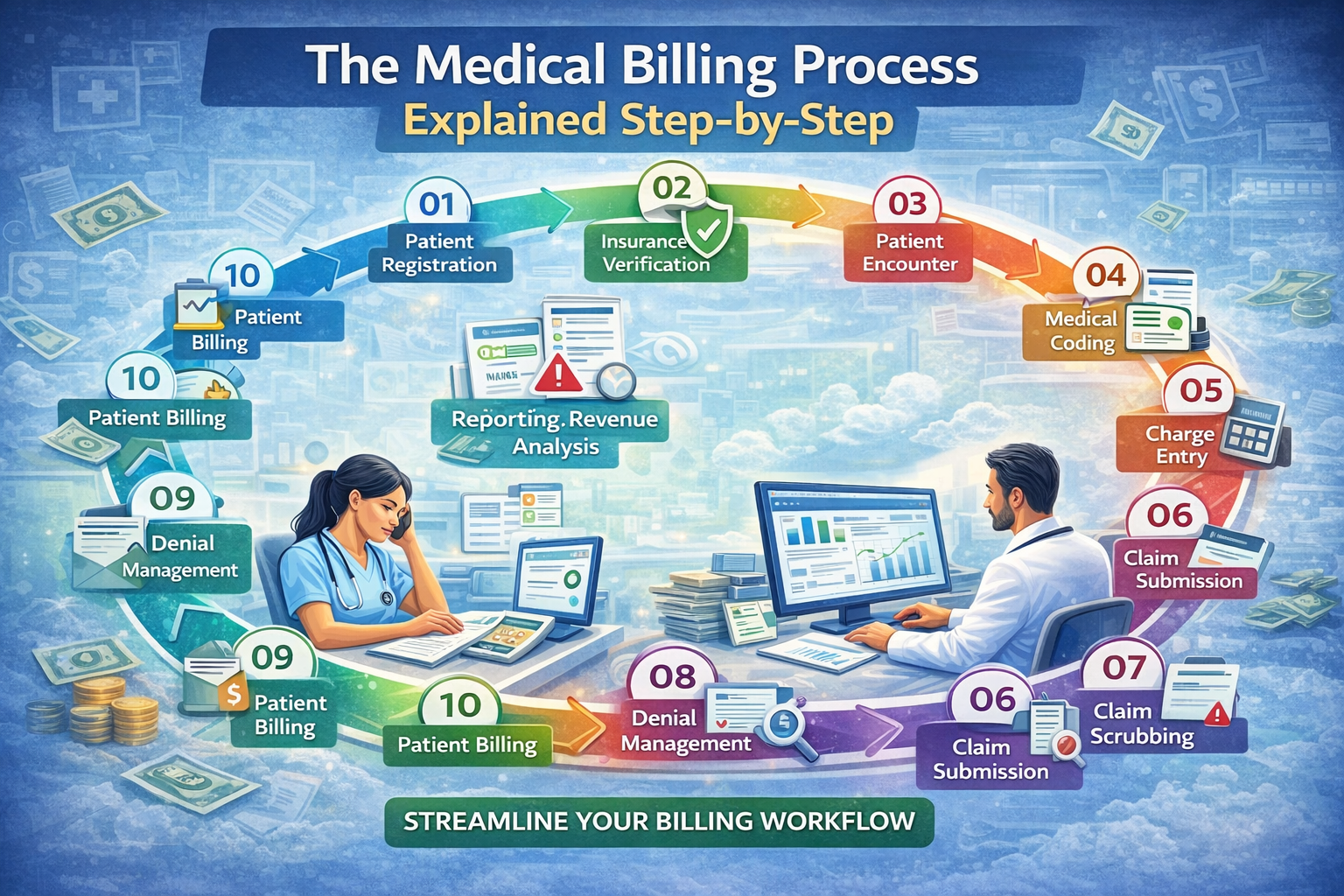
The Medical Billing Process Explained Step-by-Step
The medical billing process is a structured workflow that ensures healthcare providers are reimbursed accurately for the services they deliver. Each step in the process plays a crucial role in maintaining cash flow, reducing claim denials, and supporting compliance. When any part of this process breaks down, it can lead to delayed payments, lost revenue, and administrative stress.
This article explains the medical billing process step-by-step, helping healthcare providers understand how claims move from patient visits to final reimbursement.
Overview of the Medical Billing Process
Medical billing begins when a patient schedules an appointment and ends when full payment is received from insurance companies and patients. The process involves coordination between front-desk staff, clinical teams, coders, billers, insurance payers, and patients.
A well-structured billing workflow is an essential part of revenue cycle management, which directly impacts the financial health of healthcare practices. Learn more in our guide on how medical billing impacts revenue cycle management:
Why a Step-by-Step Approach Matters
Breaking the billing workflow into clear steps allows practices to identify inefficiencies, reduce errors, and improve overall revenue cycle management.
Healthcare providers that focus on clean claims and efficient billing workflows experience faster reimbursements and fewer denials.
Step 1: Patient Registration
The medical billing process starts with patient registration.
Collecting Accurate Patient Information
Front-desk staff gather essential information such as:
-
Patient name and contact details
-
Date of birth
-
Insurance provider and policy number
-
Identification documents
Accurate data entry at this stage prevents claim rejections later in the process.
Incorrect patient information is actually one of the most common reasons claims get rejected. You can learn more about this in our article on common medical billing mistakes that cost providers money.
Step 2: Insurance Verification and Eligibility Check
Before services are rendered, insurance eligibility must be verified.
Confirming Coverage Details
This step confirms:
-
Active insurance coverage
-
Covered services
-
Co-pays, deductibles, and co-insurance
-
Prior authorization requirements
Verifying insurance upfront reduces unpaid claims and billing disputes.
Proper insurance verification is also a key strategy in reducing claim denials in medical billing.
Step 3: Patient Encounter and Documentation
During the patient visit, healthcare providers document diagnoses, procedures, and services provided.
Importance of Accurate Clinical Documentation
Clear and detailed documentation supports medical necessity and ensures accurate coding. Incomplete or unclear notes often lead to claim denials.
Step 4: Medical Coding
Medical coding converts clinical documentation into standardized codes.
Common Coding Systems Used
-
ICD-10 for diagnoses
-
CPT for procedures and services
-
HCPCS for supplies and non-physician services
Accurate coding ensures proper reimbursement and compliance with payer guidelines.
Step 5: Charge Entry
Once codes are assigned, charges are entered into the billing system.
Ensuring Accurate Charge Capture
This step ensures that all billable services are recorded correctly. Missing or incorrect charges can result in lost revenue or billing errors.
Healthcare providers often improve charge capture accuracy by working with professional medical billing services.
Step 6: Claim Submission
After charge entry, claims are submitted to insurance companies.
Electronic vs Manual Claims
Most practices submit claims electronically, which reduces processing time and improves accuracy. Clean claims are more likely to be paid on the first submission.
Step 7: Claim Scrubbing and Tracking
Before submission, claims are reviewed for errors.
Preventing Rejections
Claim scrubbing tools identify issues such as missing information, invalid codes, or payer-specific errors, reducing rejections.
Monitoring Claim Status
Tracking claims ensures timely follow-up and prevents delays in reimbursement.
Step 8: Payment Posting
Once the insurance payer processes the claim, payments are issued.
Explanation of Benefits (EOB)
The EOB details how the claim was processed, including:
-
Amount billed
-
Amount paid
-
Adjustments and denials
Accurate payment posting ensures financial records remain up to date.
Step 9: Denial Management and Appeals
Denied or underpaid claims require prompt attention.
Identifying Denial Reasons
Common reasons include coding errors, missing documentation, and eligibility issues.
Appealing Denied Claims
Corrected claims are resubmitted with supporting documentation to recover lost revenue.
Strong denial management processes are essential for maintaining a healthy revenue cycle and preventing recurring claim issues.
Step 10: Patient Billing and Collections
After insurance payments are applied, remaining balances are billed to patients.
Transparent Patient Billing
Clear and easy-to-understand patient statements improve payment rates and patient satisfaction.
Step 11: Reporting and Revenue Analysis
The final step involves reviewing billing performance.
Using Reports to Improve Performance
Reports help practices track:
-
Denial rates
-
Days in accounts receivable
-
Payer performance
Data-driven insights support better financial decisions.
Common Bottlenecks in the Medical Billing Process
Even well-managed practices face challenges.
Where Delays Often Occur
-
Incomplete documentation
-
Coding errors
-
Delayed claim submission
-
Poor follow-up on denials
Identifying these bottlenecks helps improve efficiency.
Improving the Medical Billing Process
Healthcare providers can strengthen their billing workflow by:
-
Training staff regularly
-
Using modern billing software
-
Outsourcing to professional medical billing services
Many healthcare organizations improve efficiency and reduce administrative burden by partnering with experienced medical billing companies.
Conclusion
The medical billing process is a multi-step workflow that requires accuracy, coordination, and consistency. From patient registration to final payment, each step plays a vital role in a practice’s financial health.
By understanding and optimizing the medical billing process, healthcare providers can reduce errors, improve reimbursements, and ensure long-term financial stability.
A streamlined medical billing process allows providers to focus on what matters most—delivering quality patient care.