


Quick Answer
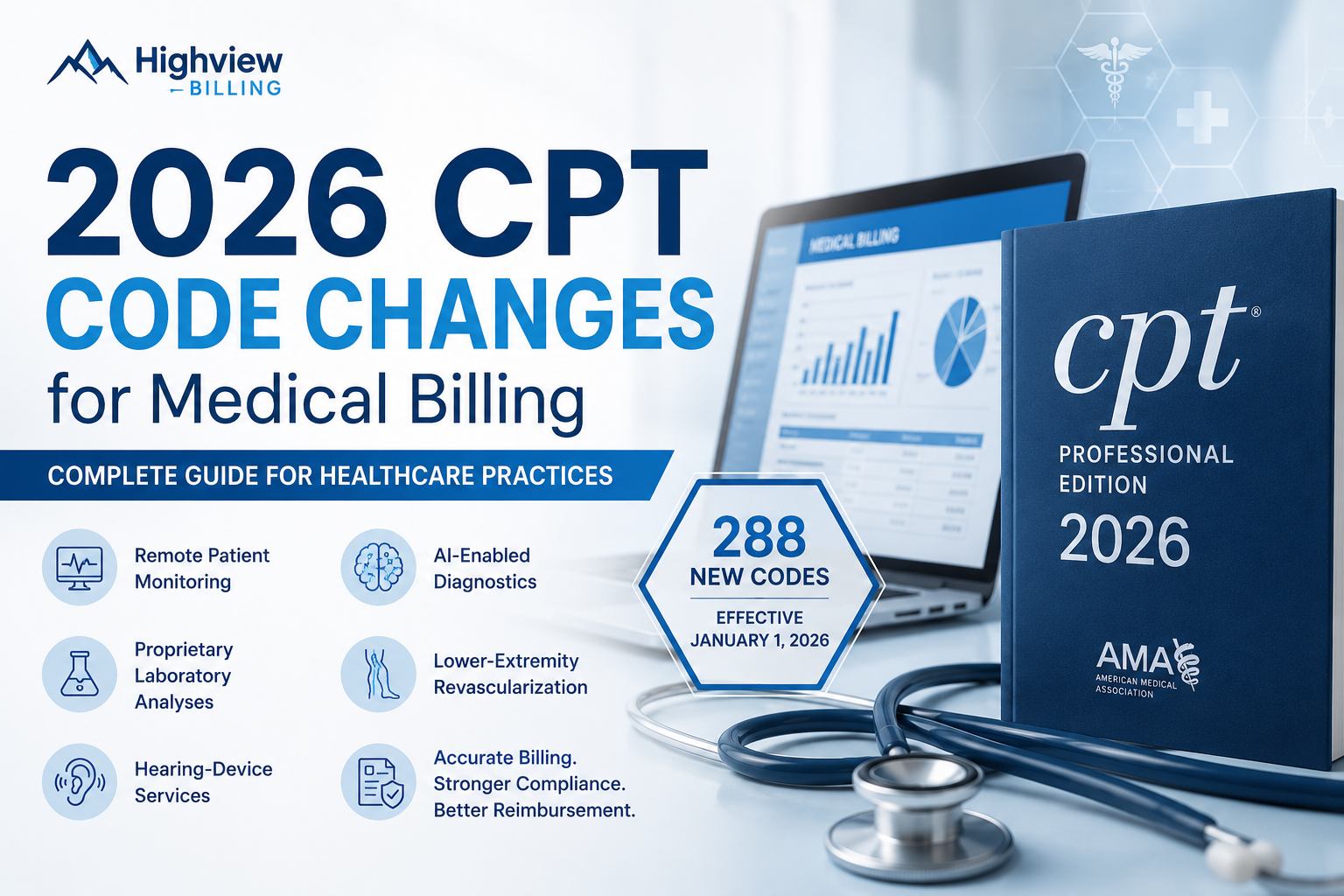
The 2026 CPT code changes for medical billing include 288 new codes, 84 deletions, and 46 revisions — 418 total changes — effective January 1, 2026. The largest updates cover remote patient monitoring (shorter-duration codes), AI-enabled diagnostic services, proprietary laboratory analyses (27% of new codes), lower-extremity revascularization (46 new codes), and hearing-device services. CMS also made separate Medicare telehealth policy changes for 2026, including updates to the Medicare Telehealth Services List.
Table of Contents
- What Changed in the 2026 CPT Code Set?
- Remote Patient Monitoring — New Shorter-Duration Codes
- AI-Enabled Medical Services Enter a New Phase
- Telehealth: Separate CPT Changes From Medicare Policy
- Lower-Extremity Revascularization: A Major Overhaul
- Proprietary Laboratory Analyses: 27% of New Codes
- What the 2026 Changes Mean for Your Billing Workflow
- CPT vs HCPCS vs Medicare Policy: The Key Difference
- 2026 CPT Implementation Checklist
- Frequently Asked Questions
- Official Sources
The 2026 CPT code changes for medical billing are not a routine annual refresh. The American Medical Association (AMA) CPT 2026 code set introduced 288 new codes, 84 deletions, and 46 revisions — 418 total changes — with major developments in remote monitoring, AI-enabled diagnostics, hearing-device services, proprietary laboratory analyses, and lower-extremity revascularization.
Consequently, for billing teams, the risk is not simply missing a new code number. It is submitting claims using deleted codes, missing new documentation requirements for AI-enabled services, or confusing AMA CPT changes with separate CMS Medicare policy updates — any of which can produce denials, delayed reimbursement, or compliance flags.
According to the AMA, the 2026 CPT code set now contains more than 11,520 CPT codes total. This guide explains the most important changes, their practical billing implications, and how to update your revenue-cycle workflow without creating avoidable claim errors.
Note for billing managers: CPT changes and CMS Medicare policy changes are published separately. A valid CPT code does not guarantee Medicare or commercial payer reimbursement. Both need to be tracked.
1. What Changed in the 2026 CPT Code Set? {#what-changed}
The AMA’s 2026 CPT code set became effective January 1, 2026. The 418 total changes break down as:
- 288 new codes added
- 84 codes deleted
- 46 codes revised
The table below shows the key areas affected and which specialties should prioritize review:
| 2026 Development | What Changed | Who Should Review |
|---|---|---|
| Remote patient monitoring | New short-duration monitoring codes; lower treatment-management time threshold | Primary care, cardiology, chronic-care, digital health |
| AI-enabled services | New codes for assistive and augmentative AI applications | Radiology, cardiology, technology-enabled specialties |
| Lower-extremity revascularization | 46 new codes; comprehensive code-family restructuring | Vascular surgery, interventional radiology |
| Proprietary Laboratory Analyses (PLA) | 27% of all new 2026 CPT codes | Laboratories, specialty diagnostic practices |
| Hearing-device services | New CPT service codes | Audiology, otolaryngology |
| CMS policy updates | Separate Medicare payment, telehealth, and coding-policy changes | All practices billing Medicare |
Notably, proprietary laboratory analyses account for 27% of new CPT 2026 codes, while Category III codes for emerging medical services account for another 27% — making advanced diagnostics and emerging technology the two largest drivers of this year’s additions.
2. Remote Patient Monitoring — New Shorter-Duration Codes {#rpm}
Remote monitoring is one of the most significant digital-health areas in CPT 2026.
The AMA added five new codes for remote monitoring services covering 2–15 days within a 30-day period. It also added two new remote-monitoring treatment-management codes that begin after just 10 minutes of service per calendar month, compared with the previous 20-minute threshold.
What this means for billing teams
Previously, some monitoring workflows were difficult to capture when the patient’s monitoring period or treatment-management time did not meet the available CPT framework thresholds.
“In addition, the 2026 changes provide reporting options for shorter monitoring periods. However, practices should not simply substitute a new code whenever a patient has fewer monitoring days.
Before reporting a new RPM code, coders must verify:
- The exact 2026 CPT descriptor and guidelines for that code
- The monitoring period documented in the medical record
- The type of monitoring service actually performed
- The treatment-management activity documented and by whom
- Any applicable commercial or Medicare payer requirements
Related: Understanding Remote Patient Monitoring Billing — link to your RPM billing article if available
3. AI-Enabled Medical Services Enter a New Phase {#ai-cpt}
CPT 2026 introduces several new codes for assistive and augmentative AI-enabled medical services — a first in CPT history at this scale.
For instance, examples include coronary atherosclerotic plaque assessment derived from analysis of coronary CT angiography data, and perivascular fat analysis for cardiac risk, using software analysis to generate clinically meaningful risk information.
The critical billing distinction
Specifically,”the AMA’s CPT AI taxonomy categorizes AI applications as assistive , augmentative, or autonomous. The category matters because different code types have different documentation and physician-involvement requirements.
The existence of an AI tool in a practice does not automatically qualify a claim for a new AI CPT code. The service performed and documented must match the specific CPT descriptor and requirements.
Ask these two questions before billing an AI-enabled CPT code:
- “Does the service performed match the specific CPT descriptor for this AI-enabled code?”
- “Does the documentation satisfy the requirements for physician interpretation and clinical use?”
That distinction prevents both undercoding (failing to bill a legitimately billable service) and unsupported billing (claiming an AI code when the service does not meet the descriptor).
4. Telehealth: Separate CPT Changes From Medicare Policy {#telehealth}
Telehealth is the area where medical billing articles most often create confusion, because AMA CPT coding and CMS Medicare telehealth policy are separate systems.
AMA CPT telemedicine codes
The AMA introduced dedicated telemedicine E/M CPT codes — including codes 98000–98016 — in the 2025 CPT cycle, not as a new 2026 creation.
CMS Medicare telehealth policy changes for 2026
CMS made significant Medicare-specific telehealth changes for 2026:
- Removed the distinction between provisional and permanent services on the Medicare Telehealth Services List
- Finalized a process under which services added to the list are treated as permanent
- Added several new services to the 2026 Medicare Telehealth Services List
- Permanently removed frequency limitations for subsequent inpatient visits, subsequent nursing-facility visits, and critical-care consultations
- Established rules allowing virtual direct supervision through real-time audio-video communication for certain services beginning in 2026
The billing lesson
| System | Authority | What It Controls |
|---|---|---|
| AMA CPT | American Medical Association | Which codes exist and what service they describe |
| Medicare telehealth policy | CMS | Which telehealth services Medicare covers and how |
| Commercial payer policy | Individual insurer | Payer-specific telehealth coverage and reimbursement |
A CPT code existing in the 2026 code set does not by itself mean Medicare or a commercial payer will reimburse it for a telehealth encounter.
Related: Medical Billing Services for Telehealth Practices — link to your telehealth billing article
5. Lower-Extremity Revascularization: A Major Overhaul {#revascularization}
Therefore,CPT 2026 includes a comprehensive restructuring of lower-extremity revascularization coding, with 46 new codes in this area.
This is particularly important for:
- Vascular surgeons
- Interventional radiologists
- Cardiovascular specialists
- Hospital outpatient departments
- Coding teams handling complex vascular procedures
When a code family undergoes broad restructuring, the risk extends beyond the code number itself. Practices should review procedure documentation, code-selection logic, claims-edit rules, modifier requirements, fee schedules, and encoder software updates.
Recommended implementation sequence for revascularization changes:
- Procedure performed →
- Documentation reviewed →
- 2026 CPT descriptor matched →
- Applicable guidelines checked →
- Modifier requirements validated →
- Payer edits tested →
- Claim submitted
For complex procedural specialties, a “download the new code set” approach is not a sufficient implementation strategy.
6. Proprietary Laboratory Analyses: 27% of New Codes {#pla}
Proprietary Laboratory Analyses (PLA) codes represent 27% of all new CPT 2026 codes— making this the single largest category of new additions in this cycle.
PLA codes are specialized CPT codes used to identify proprietary laboratory tests — including certain advanced diagnostic laboratory tests and FDA-cleared or FDA-approved clinical diagnostic laboratory tests — where a standard CPT Category I code does not exist.
Key questions for laboratory billing teams
Before submitting a PLA code claim:
- Has the relevant test received a new or revised PLA code in 2026?
- Is the previously used code still active, or was it deleted?
- Does the test descriptor accurately match the laboratory service performed?
- Does the payer recognize the PLA code and have a coverage policy?
- Are medical-necessity documentation requirements applicable?
- Has the claim system been updated with the current PLA code library?
Code availability and reimbursement remain separate questions — a PLA code existing in the CPT set does not guarantee a specific payer will reimburse it.
Related: How Revenue Cycle Management Improves Healthcare Profitability — link to your RCM article
7. What the 2026 Changes Mean for Your Billing Workflow {#workflow}
Furthermore,updating the codebook is only the first step. Practices should review the entire coding-to-payment workflow in five stages.
Step 1: Identify affected codes
Export the CPT codes your practice actually bills. Compare them against the full list of 2026 additions, deletions, and revisions. Prioritize codes that are:
- Frequently billed or high dollar value
- Recently revised or deleted
- Replaced by new codes
- Associated with new technology or AI tools
- Currently generating elevated denials
Step 2: Update all coding and billing systems
Check every system that contains coding logic:
- EHR (electronic health record)
- Practice management software
- Encoder and code reference tools
- Charge master
- Fee schedule
- Claim scrubber and edit rules
- Clearinghouse
- Clinical documentation templates
Updating only the EHR while leaving an outdated claim-scrubber rule in place can still generate denials on correctly coded claims.
Step 3: Test before going live
Create representative test claims covering three scenarios:
- Pass case: Documentation clearly and completely supports the code
- Borderline case: Documentation contains an ambiguity requiring coding review
- Fail case: Documentation does not support the code being reported
Testing all three scenarios identifies workflow problems before they become production denials.
Step 4: Review payer-specific rules
Never assume that a CPT coding change automatically changes payer reimbursement. Medicare Administrative Contractors (MACs), Medicare itself, and commercial payers each publish separate coverage and payment policies. All three must be reviewed independently.
Step 5: Monitor denials after implementation
Track denial patterns after going live with 2026 codes. Spikes in any of the following may indicate a coding or policy change that has not been fully implemented:
- Invalid-code denials
- Modifier denials
- Medical-necessity denials
- Noncovered-service denials
- Additional documentation requests
- Authorization-related denials
Related: Common Medical Billing Mistakes That Hurt Practice Revenue — link to your denial management article
8. CPT vs HCPCS vs Medicare Policy: The Key Difference {#cpt-vs-hcpcs}
One of the most common sources of billing errors is treating every coding update as a “CPT update.”
| System | Primary Authority | Main Purpose |
|---|---|---|
| CPT | American Medical Association | Describes medical, surgical, and diagnostic services |
| HCPCS Level II | CMS | Codes for supplies, products, drugs, and services not in CPT |
| Medicare payment policy | CMS | Determines Medicare coverage, payment, and billing requirements |
| Commercial payer policy | Individual insurer | Payer-specific coverage and reimbursement rules |
According to CMS, quarterly HCPCS updates are published in January, April, July, and October each year — separate from the annual January CPT release.
Why this distinction matters in practice
As a result,” a practice can simultaneously have:
- A valid CPT code for the service,
- Correct, complete documentation,
- A correctly generated claim,
…and still receive a denial because of payer coverage policy or medical-necessity requirements.
Strong 2026 coding compliance means monitoring both codes and policies throughout the year — not just updating the code set once in January.
9. 2026 CPT Implementation Checklist {#checklist}
Use this checklist before considering your 2026 coding update complete:
☐ Compare billed CPT codes against the full 2026 change list (288 new, 84 deleted, 46 revised)
☐ Identify deleted codes your practice has billed recently
☐ Identify revised codes and review updated descriptors
☐ Identify new codes relevant to your specialty mix
☐ Update EHR and practice management system code libraries
☐ Update encoder and claim-scrubber rule databases
☐ Review and update charge master and fee schedule mappings
☐ Check modifier and documentation requirements for changed codes
☐ Create and run test claims (pass, borderline, and fail cases)
☐ Review Medicare Administrative Contractor (MAC) guidance
☐ Check commercial payer-specific policies for affected codes
☐ Monitor denial patterns after implementation
☐ Document changes in an internal coding-change log
☐ Schedule review of CMS quarterly HCPCS updates: April, July, October 2026
Important: 2026 CPT compliance is not a one-time January exercise. CMS quarterly HCPCS updates and ongoing Medicare policy changes require monitoring throughout the year.
10. Frequently Asked Questions About 2026 CPT Code Changes {#faq}
What are the biggest CPT code changes for 2026?
The 2026 CPT code set adds 288 new codes across five major areas: remote patient monitoring (shorter-duration monitoring and lower treatment-management time thresholds), AI-enabled diagnostic services (coronary plaque assessment, cardiac risk analysis), proprietary laboratory analyses (27% of new codes). Therefore,lower-extremity revascularization (46 new codes), and hearing-device services. The AMA reports 418 total changes, including 84 deletions and 46 revisions.
How many new CPT codes were added in 2026?
The AMA added 288 new CPT codes in the 2026 cycle, with 84 deletions and 46 revisions, for 418 total changes effective January 1, 2026.
Did CPT add new remote patient monitoring codes in 2026?
Yes. CPT 2026 adds five new codes covering remote monitoring over 2–15 days within a 30-day period, plus two new remote-monitoring treatment-management codes using a 10-minute activity threshold (down from 20 minutes).
Did CPT add new telehealth codes in 2026?
The dedicated telemedicine E/M CPT codes (including 98000–98016) were introduced in the 2025 CPT cycle. For 2026, CMS separately updated the Medicare Telehealth Services List and removed certain frequency limitations for inpatient visits, nursing-facility visits, and critical-care consultations.
Can a practice bill an AI CPT code simply because it uses AI?
No. The AMA’s CPT AI taxonomy requires that the specific service performed — and documented — match the CPT descriptor for that AI-enabled code. Using an AI software tool in the practice does not by itself qualify a claim for a new AI-enabled CPT code.
Does having a valid CPT code guarantee reimbursement?
No. CPT describes the service, but reimbursement depends on applicable payer coverage policy, medical necessity documentation, Medicare-specific billing rules, and commercial payer requirements. All three systems — CPT, CMS policy, and commercial payer policy — must be checked independently.
What is the difference between CPT codes and HCPCS codes?
CPT codes (maintained by the AMA) describe medical, surgical, and diagnostic services. HCPCS Level II codes (maintained by CMS) cover supplies, products, drugs, and services not represented in CPT. CMS publishes quarterly HCPCS updates in January, April, July, and October — separate from the annual CPT code release.
When do the 2026 CPT code changes take effect?
The main 2026 CPT code set took effect January 1, 2026. CMS also publishes quarterly HCPCS and Medicare policy updates throughout the year, with files published in April, July, and October 2026.
What are proprietary laboratory analyses (PLA) codes in CPT 2026?
PLA codes are specialized CPT codes identifying proprietary laboratory tests — including advanced diagnostic tests and FDA-cleared or FDA-approved tests — where a standard CPT Category I code does not exist. According to the AMA, PLA codes represent 27% of the new codes added in CPT 2026, making them the single largest category of new additions this cycle.
Final Takeaway
The 2026 CPT code changes for medical billing represent a significant shift toward more detailed coding for digital health, remote monitoring, AI-enabled diagnostics, advanced laboratory testing, and complex vascular procedures.
The strongest billing teams will use a repeatable process throughout the year:
Identify → Map → Test → Deploy → Audit
Identify codes that changed. Map them to your actual clinical workflows. Test representative claims. Deploy updates across all billing systems — EHR, encoders, claim scrubbers, charge master. Then audit denial patterns and monitor CMS quarterly HCPCS updates through October.
Treating 2026 as a one-time January exercise is the fastest way to accumulate preventable denials.
For practices without sufficient internal resources to track code updates, payer rules, claim edits, and denial follow-up throughout the year, a specialized medical billing service can provide operational support — but the underlying coding process should remain documented and auditable.
Coding Disclaimer
CPT® codes are maintained by the American Medical Association. The information in this article is for educational purposes only and is not a substitute for the current CPT code set, official AMA coding guidelines, payer policies, Medicare instructions, or professional coding advice. Always verify the current code descriptor, documentation requirements, and applicable payer rules before submitting a claim.
Official Sources & Further Reading {#sources}
American Medical Association — CPT 2026 Code Set https://www.ama-assn.org/press-center/ama-press-releases/ama-releases-cpt-2026-code-set
AMA — 288 New CPT Codes Cover Digital Health, AI and More https://www.ama-assn.org/practice-management/cpt/288-new-cpt-codes-cover-digital-health-ai-and-more
AMA — CPT Coding Resources https://www.ama-assn.org/practice-management/cpt/cpt-coding-resources
AMA — CPT Appendix S: AI Taxonomy for Medical Services https://www.ama-assn.org/practice-management/cpt/cpt-appendix-s-taxonomy-artificial-intelligence-medical-services-procedures
AMA — CPT Proprietary Laboratory Analyses (PLA) Codes https://www.ama-assn.org/practice-management/cpt/cpt-pla-codes
CMS — HCPCS Quarterly Update Files https://www.cms.gov/medicare/coding-billing/healthcare-common-procedure-system/quarterly-update
CMS — CY 2026 Medicare Physician Fee Schedule Final Rule Summary https://www.cms.gov/files/document/mm14315-medicare-physician-fee-schedule-final-rule-summary-cy-2026.pdf
CMS — Telehealth and Remote Monitoring https://www.cms.gov/files/document/mln901705-telehealth-remote-monitoring.pdf