


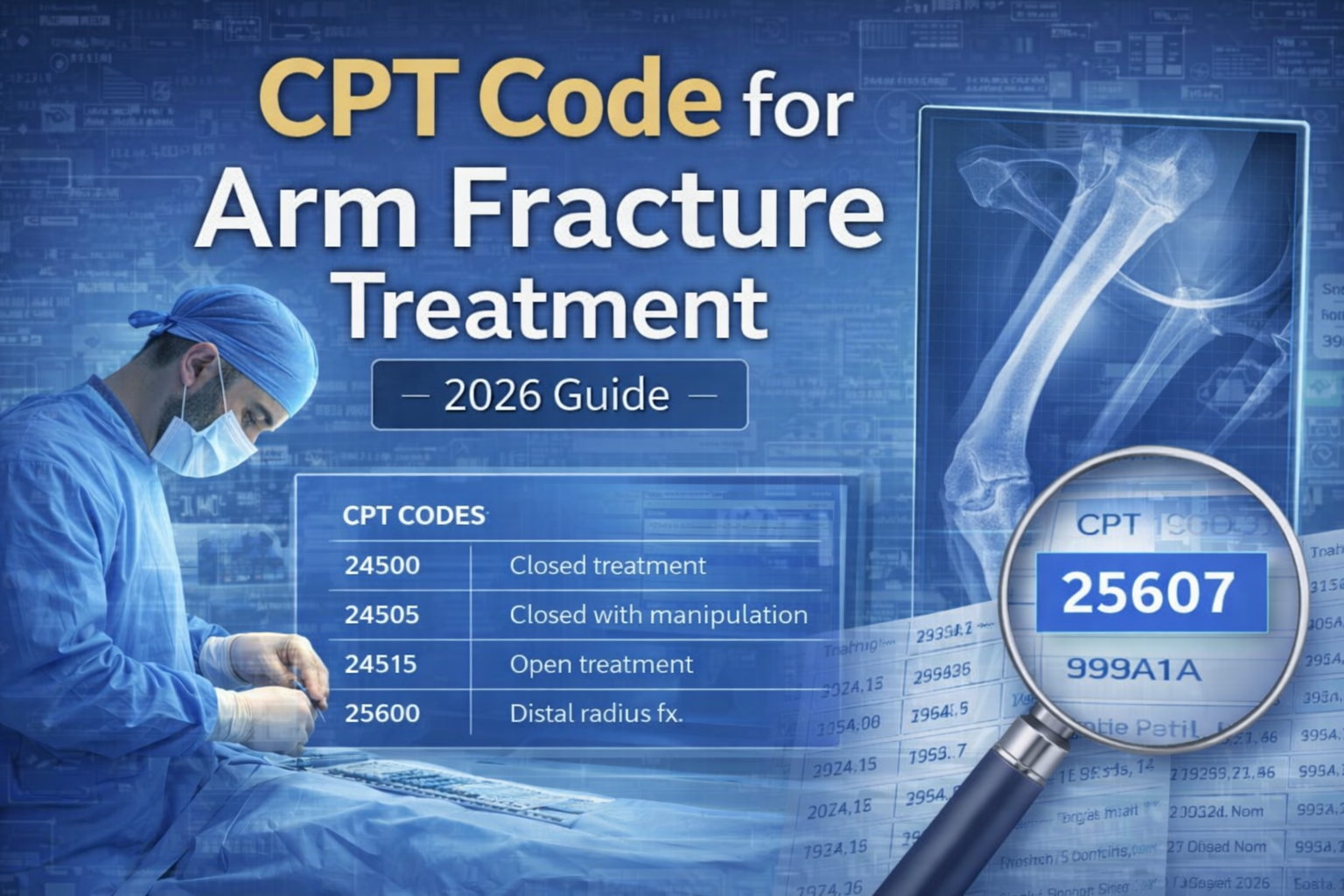
Arm fractures are among the most common orthopedic injuries treated in hospitals, urgent care, and specialty clinics. For accurate reimbursement, it is essential to use the correct CPT codes for arm fracture treatment along with proper ICD-10 diagnosis codes.
In this 2026 guide, we’ll explain the most commonly used CPT codes, billing guidelines, and how to choose the correct code.
What Is a CPT Code for Arm Fracture?
A CPT (Current Procedural Terminology) code is used by healthcare providers to report medical, surgical, and diagnostic procedures to insurance companies.
For arm fractures, CPT codes depend on:
- Type of fracture (open or closed)
- Location (humerus, radius, ulna)
- Treatment method (surgical or non-surgical)
Common CPT Codes for Arm Fracture Treatment
Below are the most frequently used CPT codes for arm fracture billing:
Humerus (Upper Arm) Fractures
- 24500 – Closed treatment of humeral shaft fracture (without manipulation)
- 24505 – Closed treatment with manipulation
- 24515 – Open treatment of humeral shaft fracture
Radius & Ulna (Forearm) Fractures
- 25500 – Closed treatment of radial shaft fracture
- 25505 – Closed treatment with manipulation
- 25515 – Open treatment of radial shaft fracture
Distal Radius (Wrist Area)
- 25600 – Closed treatment of distal radius fracture
- 25605 – Closed treatment with manipulation
- 25607 – Open treatment with internal fixation
Elbow Fractures
- 24650 – Closed treatment of radial head fracture
- 24655 – Closed treatment with manipulation
- 24665 – Open treatment of radial head fracture
How to Choose the Correct CPT Code
Selecting the correct CPT code is critical for proper reimbursement. Follow these steps:
1. Identify the fracture location
Determine if the fracture is in:
- Humerus (upper arm)
- Radius/Ulna (forearm)
- Elbow joint
2. Determine treatment type
- Closed treatment (no surgery)
- Closed with manipulation (bone repositioning)
- Open treatment (surgical procedure)
3. Check documentation
Ensure the physician notes clearly mention:
- Procedure performed
- Technique used
- Fracture severity
ICD-10 Codes for Arm Fractures (Diagnosis)
To support CPT billing, use appropriate ICD-10 diagnosis codes:
- S42.301A – Unspecified fracture of humerus
- S52.501A – Fracture of radius
- S52.121A – Fracture of radial head
- S40.021A – Contusion of upper arm
Always match ICD-10 codes with laterality (right/left) and encounter type.
Common Billing Mistakes to Avoid
Avoid these common errors in arm fracture coding:
- Using incorrect CPT code for treatment type
- Missing documentation for manipulation
- Not linking CPT with correct ICD-10 code
- Ignoring modifiers when required
Pro Tips for Medical Billing Success
- Use modifiers (e.g., LT, RT) for laterality
- Verify payer-specific guidelines
- Ensure proper documentation before claim submission
- Regularly update coding knowledge for 2026 changes
Conclusion
Accurate use of CPT codes for arm fracture treatment is essential for proper reimbursement and compliance. By selecting the correct code based on fracture type and treatment method, healthcare providers can reduce claim denials and improve revenue cycle efficiency.