


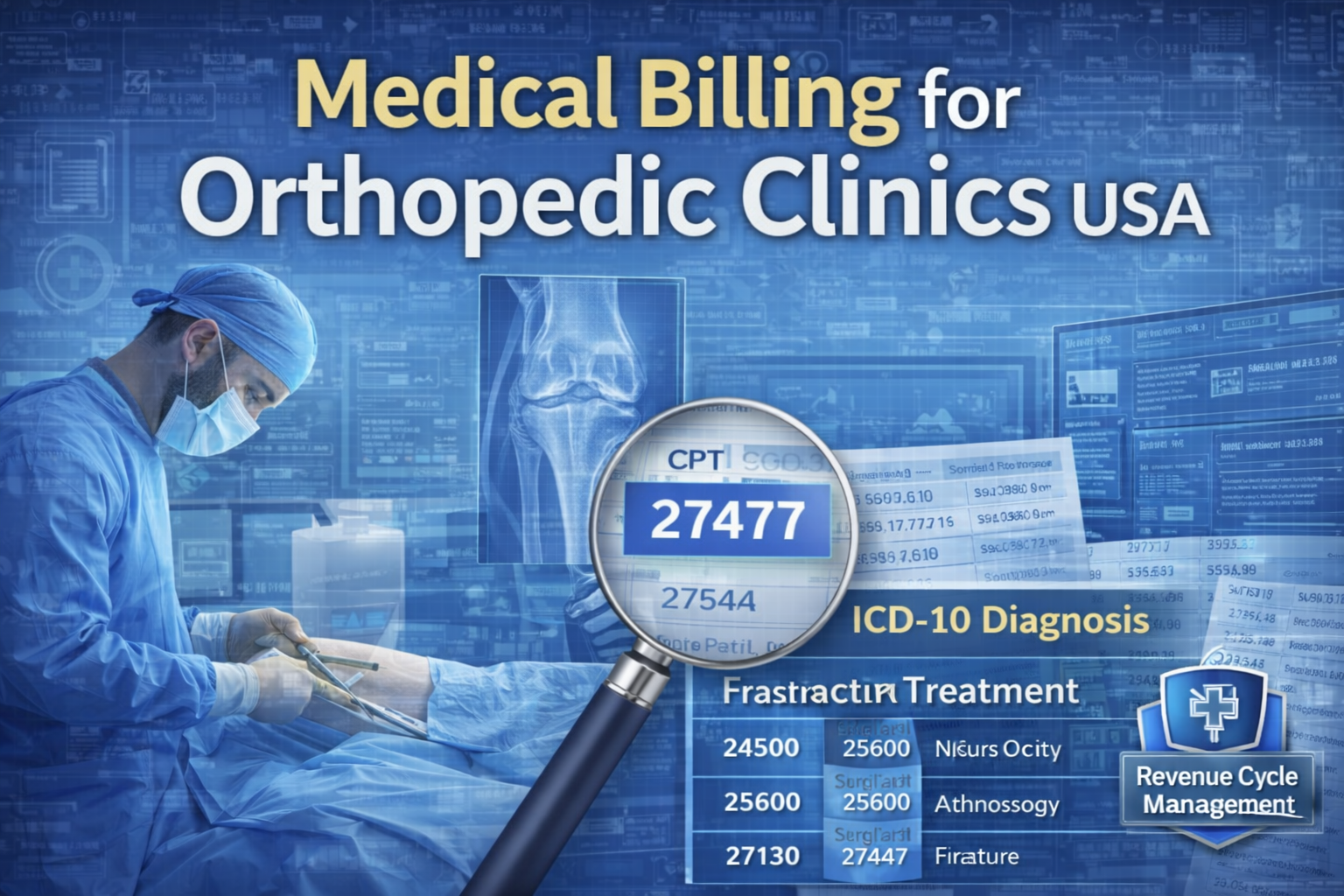
Medical billing for orthopedic clinics in the USA is a specialized process that requires accurate coding, proper documentation, and efficient revenue cycle management. Orthopedic practices deal with complex procedures such as fractures, joint replacements, and musculoskeletal treatments, making precise billing essential for maximizing reimbursement.
This guide explains how orthopedic medical billing works, key challenges, and best practices to improve revenue.
What Is Orthopedic Medical Billing?
Orthopedic medical billing is the process of submitting and following up on claims for services related to the musculoskeletal system, including bones, joints, ligaments, and muscles.
It involves:
- CPT coding for procedures
- ICD-10 coding for diagnoses
- Insurance claim submission
- Payment posting and denial management
Common CPT Codes Used in Orthopedic Billing
Orthopedic clinics frequently use the following CPT codes:
Fracture Treatment
- 24500 – Closed treatment of humeral shaft fracture
- 25500 – Closed treatment of radial shaft fracture
- 25600 – Closed treatment of distal radius fracture
Surgical Procedures
- 27130 – Total hip arthroplasty (hip replacement)
- 27447 – Total knee arthroplasty (knee replacement)
Arthroscopy
- 29881 – Knee arthroscopy with meniscectomy
- 29827 – Shoulder arthroscopy with rotator cuff repair
ICD-10 Codes in Orthopedic Billing
Diagnosis codes must support the procedures billed. Common examples include:
- S42.301A – Fracture of humerus
- S52.501A – Fracture of radius
- M17.11 – Osteoarthritis of right knee
- M75.101 – Rotator cuff tear
Correct ICD-10 coding ensures claim approval and reduces denials.
Key Challenges in Orthopedic Medical Billing
Orthopedic billing is complex due to several factors:
1. Complex Procedures
Surgeries often involve multiple steps requiring accurate CPT coding.
2. Frequent Use of Modifiers
Modifiers like -RT, -LT, -59, and -25 are commonly required.
3. High Denial Rates
Incorrect coding or missing documentation can lead to claim rejections.
4. Pre-Authorization Requirements
Many orthopedic procedures require insurance approval before treatment.
Revenue Cycle Management (RCM) for Orthopedic Clinics
A strong RCM process helps clinics improve cash flow and reduce errors.
Steps in Orthopedic RCM:
- Patient registration and insurance verification
- Medical coding (CPT & ICD-10)
- Claim submission
- Payment posting
- Denial management and appeals
Best Practices for Orthopedic Billing Success
To optimize billing performance, clinics should follow these strategies:
- Ensure accurate and updated coding
- Use certified medical coders
- Verify insurance eligibility before procedures
- Maintain proper documentation
- Track and reduce claim denials
- Use billing software or outsource services
Benefits of Outsourcing Orthopedic Medical Billing
Many clinics in the USA outsource billing to improve efficiency.
Advantages:
- Reduced administrative workload
- Faster claim processing
- Improved revenue collection
- Compliance with latest regulations
- Access to expert coders
Why Choose Professional Medical Billing Services?
Professional billing companies specialize in:
- Orthopedic coding accuracy
- Denial management
- Compliance with CMS guidelines
- Maximizing reimbursements
This allows physicians to focus on patient care instead of administrative tasks.
Conclusion
Medical billing for orthopedic clinics in the USA requires expertise, accuracy, and a well-structured revenue cycle process. By using correct CPT and ICD-10 codes, reducing errors, and implementing best practices, clinics can significantly improve their financial performance.
Outsourcing billing services can further streamline operations and ensure compliance, making it a smart choice for growing orthopedic practices.