


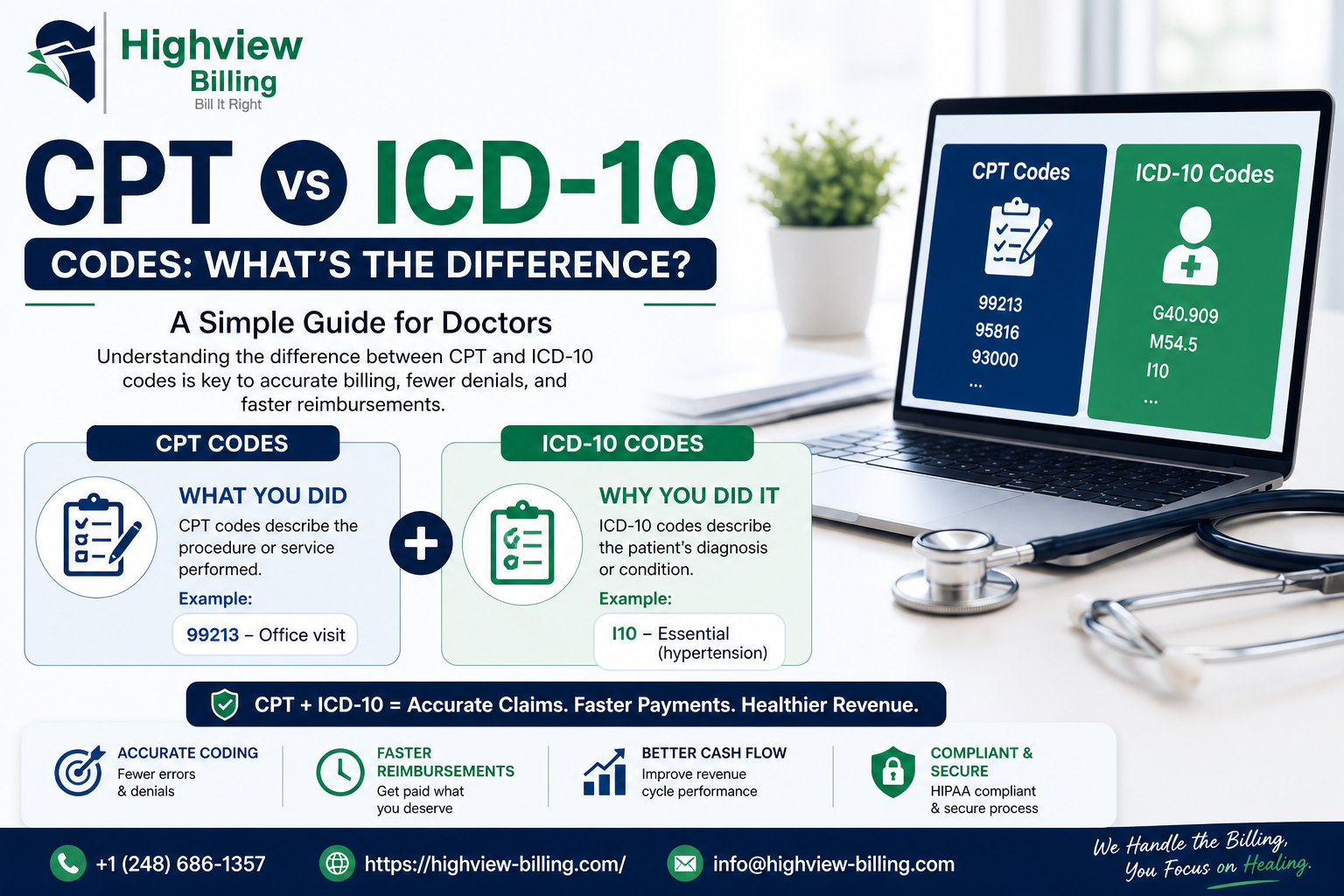
Medical billing can be confusing, especially when it comes to coding. Two of the most important code systems used in healthcare are CPT and ICD-10 codes. Understanding the difference between them is essential for accurate billing, faster reimbursements, and fewer claim denials.
At Highview Billing, we simplify medical coding so healthcare providers can focus on patient care instead of paperwork. In this guide, we’ll explain CPT vs ICD-10 codes in the simplest way possible.
What Are CPT Codes?
CPT (Current Procedural Terminology) codes describe what procedure or service was performed by the healthcare provider.
These codes are maintained by the American Medical Association and are used by doctors, clinics, and hospitals to bill insurance companies.
Examples of CPT Codes:
- 99213 – Office visit (established patient)
- 95816 – EEG test
- 93000 – Electrocardiogram (ECG)
In simple words: CPT = What you did
What Are ICD-10 Codes?
ICD-10 (International Classification of Diseases, 10th Revision) codes describe the patient’s diagnosis or condition.
These codes explain why the service was needed and are used worldwide for reporting diseases and health conditions.
Examples of ICD-10 Codes:
- G40.909 – Epilepsy, unspecified
- M54.5 – Low back pain
- I10 – High blood pressure
In simple words: ICD-10 = Why you did it
Key Differences Between CPT and ICD-10 Codes
| Feature | CPT Codes | ICD-10 Codes |
|---|---|---|
| Purpose | Describes procedure/service | Describes diagnosis/condition |
| Used for | Billing & reimbursement | Medical necessity & reporting |
| Maintained by | AMA | WHO |
| Example | 99213 (office visit) | I10 (hypertension) |
Both codes are required together to create a complete and clean medical claim.
Real-Life Example (Easy to Understand)
Let’s say a patient visits a doctor due to seizures:
- Doctor performs an EEG test → CPT Code: 95816
- Diagnosis is epilepsy → ICD-10 Code: G40.909
Insurance companies need both codes:
- CPT tells them what service was done
- ICD-10 tells them why it was necessary
If these don’t match correctly, the claim may be denied.
Why Correct Coding Matters
Incorrect use of CPT or ICD-10 codes can lead to:
- Claim denials
- Payment delays
- Revenue loss
- Compliance issues
At Highview Billing, we ensure:
- Accurate code selection
- Proper CPT + ICD linking
- Clean claim submission
- Faster reimbursements
Common Coding Mistakes to Avoid
Many providers make small mistakes that cost big money:
- Using CPT codes without matching diagnosis
- Choosing outdated or incorrect codes
- Missing modifiers
- Incomplete documentation
Even a small error can result in a denied claim.
How Highview Billing Helps
We specialize in simplifying medical billing for healthcare providers.
With Highview Billing, you get:
- Expert coding (CPT + ICD-10)
- Reduced denial rates
- Faster claim approvals
- Complete revenue cycle management
Our goal is simple: maximize your revenue while you focus on patient care.
Conclusion
Understanding CPT vs ICD-10 codes is essential for every healthcare provider. While CPT codes describe the service performed, ICD-10 codes explain the reason behind it. Both work together to ensure accurate billing and successful claim processing.
If you want to avoid coding errors and improve your cash flow, partnering with a professional billing service can make all the difference.
Highview Billing is here to make your medical billing simple, accurate, and stress-free.