


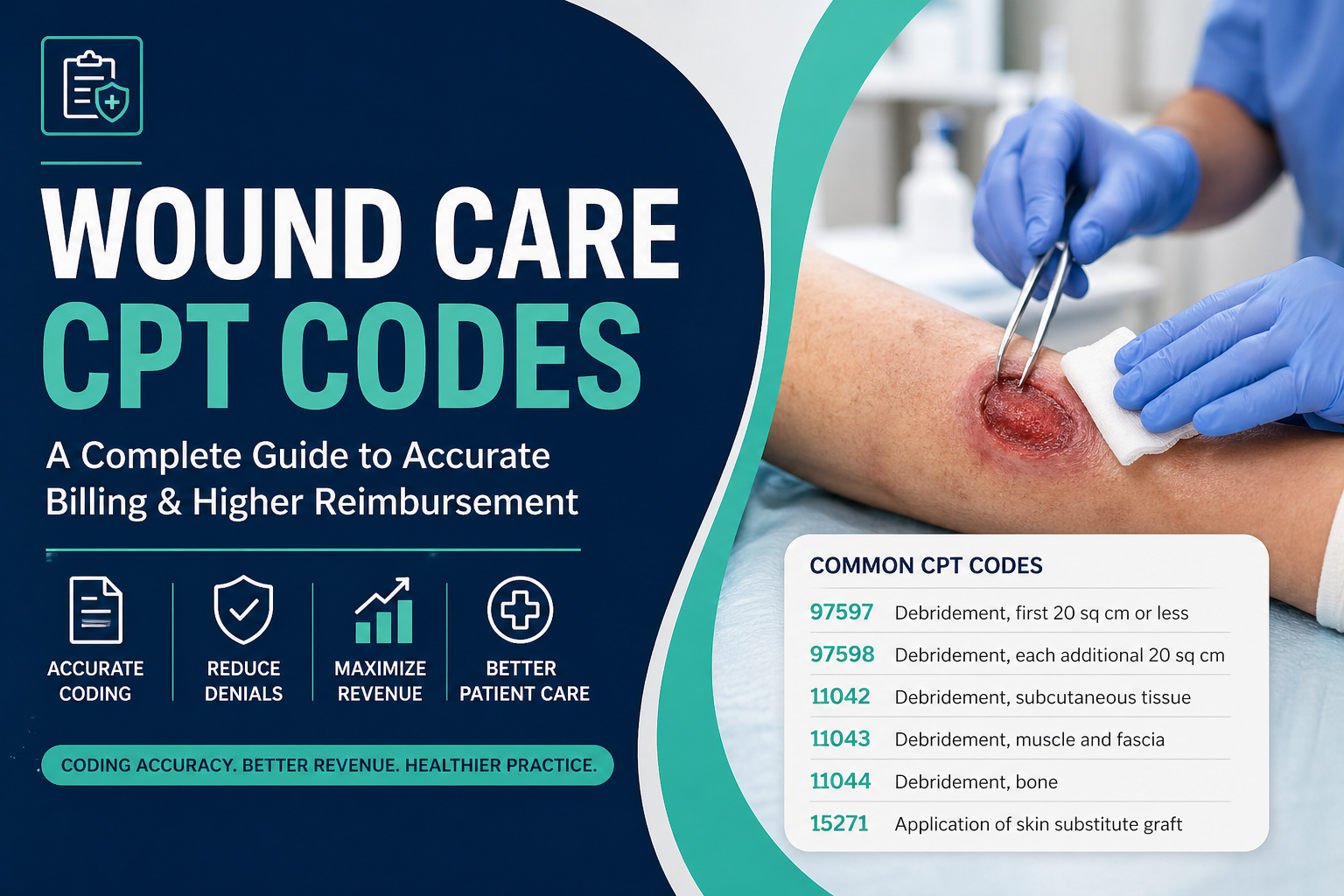
Wound care billing is one of the most detailed areas in medical billing. Many healthcare providers face claim denials due to incorrect CPT code selection, incomplete documentation, or misunderstanding of payer guidelines.
To improve reimbursement and reduce denials, it is essential to understand how wound care CPT codes work and how to apply them correctly in real clinical scenarios.
This guide provides a clear and practical breakdown of wound care coding to help your practice optimize revenue.
What Are Wound Care CPT Codes?
CPT (Current Procedural Terminology) codes are standardized codes used to describe medical procedures and services. In wound care, these codes are used for:
- Debridement procedures
- Wound assessment and management
- Dressing and treatment services
- Skin grafts and advanced therapies
Correct coding ensures that healthcare providers receive proper reimbursement while maintaining compliance with insurance requirements.
Key Factors in Wound Care Coding
Accurate wound care billing depends on three main factors:
- Depth of tissue removed
- Total wound surface area (in square centimeters)
- Type of procedure performed
Among these, the most important factor is the depth of tissue actually debrided, not just the visible wound depth.
Debridement CPT Codes
Debridement is the most commonly billed wound care service and requires careful code selection.
Selective Debridement (Non-Surgical)
- 97597 – First 20 sq cm or less
- 97598 – Each additional 20 sq cm
These codes are used when removing non-viable tissue without surgical intervention.
Surgical Debridement Codes
- 11042 – Subcutaneous tissue
- 11043 – Muscle and fascia
- 11044 – Bone
- 11045–11047 – Each additional 20 sq cm
Important Rule:
Always report the code based on the deepest level of tissue removed during the procedure.
Active Wound Care Management Codes
These codes are used for ongoing wound treatment and advanced therapies:
- 97602 – Non-selective debridement
- 97605 – Negative pressure wound therapy (small wound)
- 97606 – Negative pressure wound therapy (large wound)
These services are often subject to bundling rules, so separate billing may not always be allowed.
Skin Substitute and Graft Codes
- 15271–15278 – Application of skin substitute grafts
These codes are used for advanced wound treatment and require:
- Accurate wound measurement
- Documentation of medical necessity
- Proper product usage details
Failure to document these elements can result in claim rejection.
Wound Repair Codes
Wound repair codes are different from wound care codes and should only be used when closing a wound:
- 12001–12018 – Simple repair
- 13100–13160 – Complex repair
These codes are not used for debridement or routine wound care management.
Documentation Requirements for Wound Care Billing
Accurate documentation is critical for successful reimbursement. Each patient record should include:
- Wound size (length × width in square centimeters)
- Depth of tissue removed
- Type of tissue (necrotic, muscle, bone)
- Procedure performed
- Clinical justification and medical necessity
Incomplete or unclear documentation is one of the leading causes of claim denials.
Common Wound Care Billing Mistakes
Avoid the following common errors:
- Coding based on wound appearance instead of tissue removed
- Incorrect use of add-on codes
- Missing wound measurements
- Billing bundled services separately
- Incorrect linkage between CPT and ICD-10 codes
These mistakes can lead to delayed payments, denials, or compliance issues.
Tips to Maximize Reimbursement
To improve revenue from wound care services:
- Always code based on the deepest tissue removed
- Use add-on codes correctly for larger wounds
- Verify payer-specific billing guidelines
- Ensure proper ICD-10 code selection
- Conduct regular coding audits
Consistent accuracy in coding and documentation leads to faster payments and fewer denials.
Why Wound Care Billing Is Complex
Wound care involves multiple variables such as:
- Different wound types and stages
- Multiple wounds treated in a single visit
- Ongoing care and follow-ups
- Varying insurance requirements
Because of this complexity, many practices benefit from professional medical billing support.
How Highview Billing Can Help
Highview Billing provides specialized medical billing services designed to:
- Improve coding accuracy
- Reduce claim denials
- Optimize revenue cycle management
- Ensure compliance with payer guidelines
Our team works closely with healthcare providers to streamline billing processes and maximize collections.
Conclusion
Wound care CPT coding requires attention to detail, accurate documentation, and a strong understanding of billing guidelines. By using the correct codes and following best practices, healthcare providers can significantly improve reimbursement and reduce claim denials.
Investing in proper coding processes or working with an experienced billing partner can make a measurable difference in your practice’s financial performance.